Nan Eastep is the owner of
B. Spoke Tailor, a modern-day
company that designs and creates custom clothing the old-fashioned way, one
customer at a time.
To some readers,
this approach may seem inconsistent with Cycloculture’s claims to cover
bicycling in the real world.
Perhaps I
shared a bit of your skepticism at first, but then I read Eastep’s answers to
my questions on the practicality of custom-made clothing, and I became a
convert.
Her thoughts on beauty,
creativity and the dignity of work certainly hint at the wonders of her own
creations, but her ideas also resonated with me on a level beyond bicycle
tailoring, or even bicycles in general.
This is a person who understands why easier is not always better and what
living in a community is all about.
Cycloculture readers in the Bay Area should note that B.
Spoke Tailor is having a
Grand Opening Gala this Sunday, September 29, from 2PM until 10PM.
If you like the clothes you see here, or like
the ideas Eastep expresses, I encourage you to take a peek.
 |
| Looks like fun to me! |
Q: (Editor’s Note:
This question was originally buried in the middle of the interview, but
I moved it to the top so that, if you read anything in this interview, you read
this. Eastep’s
answer is wonderful) Would the world be
better off if everyone had their clothing custom made? If so, how?
A: Yup. Certainly.
That would mess up globalization for sure. And add beauty,
expression, quality to our world. If everyone had their clothing made by
someone nearby that they knew, there would be more people doing dignified work,
working with their hands, continuing a beautiful lineage, passing down the
skills. There would need to be support to make it happen, mills and
suppliers. This would be great for the economy. Simple exchanges over the
everyday stuff of life help to build relationships, community. And, if
made by skilled hands, the clothing would be better. It would fit better,
last longer, be more suited to our individual tastes and expression.
It is not so long ago that that was the case. Mass
production of clothing changed everything. Used to be one went to a
tailor, or to the fabric store to get their fabric, and to their seamstress to
have it sewn up. Before ready-to-wear, your old suit was your workwear.
Clothing lived longer. Bespoke suits are made so that the trouser
pockets and lining can be replaced every few years. The system was smart.
And, in a word, sustainable.
 |
A very lovely example of Eastep's handiwork
Photo by Ralph Granich |
Q: You design and create custom bicycle clothing.
What inspired you to choose this career?
A: I love making
clothing, and I love wool. As I continue to develop my skills as a
clothing maker, tailoring is a natural course for me, as opposed to other
possible paths, like couture ball gowns, which would also certainly challenge
me. Natural in that I am attracted to tailored clothing. Well made,
it is so beautiful. And it is perfectly suited for most any activity,
short of Olympic swimming. Or sleeping. As bicycling is the most
common of urban active activities, tailoring for the bicyclists puts the
clothing in service to movement, breath-ability, durability, all of which are
great whether or not you are riding.
The story I tell about beginning along this path, is that a
dear friend handed me a stack of his pants that had been chewed up in his
bicycle chain, and that stack of alterations changed my course forever. I
began making wool bike knickers.
 |
Knicker Ninjas, ATTACK!
Photo by Ralph Granich |
Q: Why have you chosen to creating individual clothes for each
customer, rather than designing and creating various lines of clothing to sell
to retailers?
A: There are a number
of reasons why. One is that there is no ready wholesale market for
tailored bike clothing. Bike shops are in the business of selling bikes,
not expensive clothing, so that has proven not to work. The fashion
industry has no niche for tailored bike clothing, either. Though cycling
is gaining in popularity, and that may change.
Personally, I would rather cut and sew B. Spoke Tailor
clothing myself, for my interest in the finished result. If I tried, and
I have, to be a manufacturer, I would not be tailoring, but managing others to
do something less than beautiful tailoring.
There are no facilities that are capable of manufacturing
the type of clothing I make. There simply is not an industry domestically
anymore. Small-scale brands have always had it tough in an economy of scale,
and that sense, none of this is news.
Due to the amount of labor involved, (cost of materials
aside) the clothing is expensive. If I do the same work to sell wholesale
for a lower price, I cannot make a living. There are very few boutiques
and clothing stores that can sell clothing at the prices it would need to
exact. And of these, which ones are interested in bicycling attire?
Tell me!
I love the direct connection I have to my customers.
Delightful.
 |
| Wow. Just... wow... |
Q: What are some of your most popular items?
A:
My cycling
breeches AKA bike knickers are still the most popular item. I also sell a
good number of trousers. More and more people are ordering vests, a great
cycling accessory. My arm warmers are also very popular. My women’s
waxed cotton raincoats are well-loved, but I am on hiatus from making them, as
I need to keep my product offerings within a manageable range. I tend to
spread myself thin.
 |
Soft, cozy goodness
Photo by Carrie Cizauska |
Q: Who buys your clothes?
A: Men and women who
live in cities and bike for transport who like style and wool and are willing
to pay for custom tailored clothing. Sartorial types. Randonneurs. Bike
messengers, mountain bikers, road and cyclocross racers. Non-cyclists who
just like the clothing. My family. Most tend to be older, say 34-60.
They want to own less clothing and really love it. Some wear it to
commute in and change at work. Some wear lycra to commute, and change at
work! My customers tell their friends about the clothing, or are seen
wearing it on the streets or trails, at work or in a cafe. It is almost
all word of mouth, though having promoted my line via Momentum and Bicycle
Times mags has helped. Facebook. The internet.
Sounds impressive, but I really don't make that many
clothes. If I am lucky, I average four garments per week.
 |
The fashion runway redefined
Photo courtesy of Richard Masoner of Cyclelicio.us bike blog |
Q: Can you really survive on the money you make as a bicycle tailor,
or do you have another side gig to help make ends meet?
A: I can and do
survive. Barely I might add. No side gigs, though I sometimes muse
on possibilities. Any ideas?
I am very frugal, don't require much to be happy. I
love to cook! Don’t own a car! My son is not a teenager.
Q: Are you a bicyclist? If so, what kind of riding do you do?
What kind of bike(s) do you have?
A: I do bicycle every
day. It is how I get around. And Jason is my tailoring mate and we
have been taking morning B. Spoke Tailor "training rides" up to the
hills. This involves about a half an hour if riding up an easy slope, he
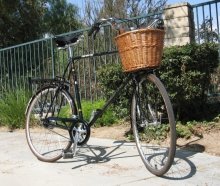
on his Bianchi cross bike, me on my clunker, an old, heavy, lugged, steel frame
Raleigh that was supposed to sit in as a loaner after an accident I had a year
ago. I bought an old, lugged Bianchi frame that fits me perfectly, and is
in the hands of Davey Archard of Brazen Bicycles. He upcyles old frames. That is more my
style. Maybe one day I'll be able to afford a new bike. Not sure
what that would be. I'll have Adam Shapiro to guide me. I have an
Xtracycle Radish for when I need to haul things, and kids.
I love to tour, though I rarely find the time. I once
road tandem down the coast to Santa Barbara.
I like to ride around Marin county, on the other side of the Golden
Gate bridge.
 |
More knickers
Photo courtesty of David Niddrie of Momentum Magazine |
Q: You live and work in one of America's bicycling centers, the Bay
Area. Do you feel like your business is a part of the local cycloculture?
Are most of your customers local?
A: I think most of my
customers at this point are local to me.
I have felt very well received by local bike culture.
Much of what is bike culture, as seen in the media and even on the
streets (like Bike Party and Critical Mass) is a young culture. If I were
younger, not a parent, not running a business, I might feel more a part of all
that, though I am not a stranger to it. I love to pop in and out as I
have the leisure for it. And to collaborate with it, like showing up to
events, putting pieces in bike fashion shows, sponsoring races and rides.
Q: I am desperately allergic to even
the very softest wool. If I wear any kind of wool, even if I have a layer
of cotton underneath it, I break out in a nasty eczema rash. What are you
recommendations for fine bicycle clothing for someone in my situation?
A:
There are many
other possibilities, what matters to me is durability. Cotton can be nice,
though if you sweat a lot, it takes a while to dry. Hemp holds less water. I
would recommend a heavy twill. The synthetics designed to emulate wool can be
good, though the treatments for wicking have a short life.
 |
Soft, smooth merino wool underwear
Photo by Ralph Granich |
Q: Are all the
clothes you make reminiscent of designs from 50-100 years ago? Or do you
design and create anything that is obviously contemporary?
A: I like to say I
make modern clothing, because I am not trying to replicate the past.
Whether you are building a house or a meal, you are drawing upon
tradition, and the best designs usually have history. So I would say all
of my clothing is modern, even though at a glance people sometimes assume it is
vintage. The techniques and cloth I am drawn to are old; manufactured
(modern) clothing has bypassed both in most cases for profitability. And
of course, spandex is another thing altogether!
Q: What else would you like to say?
A: I hope to see
merino sheep and a wool mill in Northern California
before I die.
Q: What do you like for breakfast?
A: Eggs!



 Posts
Posts


