Showing posts with label Internal Gear Hub. Show all posts

Tuesday, July 29, 2008

Sky Yaeger on Integrated Design and Derailleur-Free Riding

Sky Yaeger has been leaving her mark on the bicycle world since the 1970s. Her years at Bianchi brought us such industry-shaking models as the “Milano,” the "Pista" and the “San Jose.” She also introduced the world to the first production single-speed ATBs (the Bianchi BOSS, BASS, BUSS, MUSS, DISS ,SISS, SASS, WUSS, GUSS, MUSS and LEWIS). Since she joined Swobo in 2006, it appears that she has been given the freedom to let her imagination and her design sense run wild. The results are wonderful. Swobo’s bikes are unlike anything the world has ever seen. Who would have imagined a galvanized bicycle frame until Yaeger made it happen?

I wanted to understand Yaeger’s design philosophies and motivations, so I asked her to do an interview. I was overjoyed when she agreed.

Sky Yaeger getting silly on a Swobo Otis
Photo Courtesy of Richard Masoner and Cyclelicio.us
with some rights reserved

Q: You've been in the industry for a number of years now. Could you tell us a bit about your history with bicycles and bicycle companies?


A: My first 10-speed, as we called them, was a used bike I bought in 1970 for $60.00. I was in sophomore in high school and there was a senior who I didn't really know who had the only other bike in school. Riding a bike was not cool, but I loved the freedom. All my friends had the use of a car, so I didn't get a driver's license until I was in college and didn't get a car until I was 30 years old. I worked in a Schwinn shop in the early 70's and then worked in the famous Yellow Jersey bike shop in Madison during and after college. In the late 80's I was the marketing manager for Suntour USA and when the Japanese closed the company I went to Bianchi USA. I was there for 17 years and made the move to Swobo 2 years ago.

Yaeger's famous "100% Chick Designed" decal

Q: The Swobo bicycle product line seems to be almost Shimano-free. Why so?

A: It wasn't the goal, but more a result of the model mix, as we have no bikes with derailleurs. We have 3 single-speed bikes and 3 internal hub bikes in the line now. The Folsom has a Shimano coaster brake hub that Shimano Japan is customizing for us, with a longer axle. I like all internal hubs, but the lead times for Shimano are much longer than with SRAM now. The new SRAM i-Motion 9 hub is the only internal hub offered with 9 speeds. The SRAM internal hubs have a more user-friendly cable attachment at the hub, as well as being serviceable, by swapping out the guts, which negates a wheel re-build if there is a problem. Spec'ing high-quality German-made hubs also differentiates our bikes from everything else out there, as we are the only company in the North American market using the i-Motion 9 hub.

Swobo Dixon

Q: Do you think that derailleurs are a thing of the past? Do you think you will ever spec another bicycle with derailleurs?

A: Until we can bring an infinitely variable internal drivetrain to market at a weight the roadies could live with, derailleurs are very much not a thing of the past. I have nothing against derailleurs! I can imagine spec'ing a bike with derailleurs, yes. For most urban riding, however, an internal hub bike just makes more sense considering all the benefits. There's a reason why bikes with internal hubs are the most common type of bikes in Europe, where the primary use of bikes is for transportation.

Swobo Del Norte

Q: How many speeds does as average "urban cyclist" need?

A: For most cities with flat terrain, I think 3 speeds is enough. Certainly there are thousands of people riding one-speed fixies in hilly cities like SF, so a lot depends on the rider and the intended use. We're seeing some people who have been riding fixies wanting a 3-speed now, for more utility.

Q: Your bicycle designs are so very different from the offerings of any other company. What inspires them? Is there a design thread which ties all your Swobo bikes together?

A: My education is in fine arts and design, and I get inspiration from everything, but I look to cars and architecture a lot. In most bike companies there are many people involved in bringing a bike to market and it is very rare to have the luxury of conceptualizing a model, designing it from a blank sheet of paper and seeing it through to production. I think of them as a complete, integrated statement.

Swobo Novak

Q: I get the feeling you own quite a bicycle collection. Please tell us about some of your favorites.

A: I have a new lugged steel Pegoretti that is quite lovely and rides like a dream. My commute bike is built around an alloy/carbon-fiber cyclo-cross frame that I designed that also rides like a dream, with 700 x 28C tires. The Continental tires on that bike have almost 3000 miles on them without one flat. Another favorite is a steel Dedacciai frame with carbon rear triangle. The important thing is the ride and my favorite is whatever bike I just got finished riding. I like all frame materials, with steel and Ti being right up there. I ride Campy, Shimano and SRAM.

Yaeger with Dario Pegoretti (left) and an unidentified admirer

Q: If you did not have to worry about cost, marketability or any other mundane concerns, what would be your version of "the perfect bicycle?"


A: There is no one "perfect bicycle," but I guess it would have to be whatever inspires someone to get out and ride. One person's perfect bicycle would be another person's nightmare. There are few things in life that are as varied and personal as bicycles and the opportunity to personalize your ride is part of the appeal. I love looking at all the pimped out bikes on the Fixed Gear Gallery site. They have almost 8,000 bikes posted now. If you are talking about what I would design if a million bucks landed in my lap, it would have to be a light-weight belt-driven internal hub urban bike with integrated features like lights and locks and carrying capability integral to the frame.

Swobo Folsom

Q: Where do you see the US bicycle market/industry going over the next decade or so?

A: If gas prices continue upward, we're going to see bike sales and ridership continue to increase. Hopefully, the component companies will recognize that more engineering and R&D dollars need to get directed to internal hub technology. I'd like to see real puncture-resistant tires that ride as nice as 120 tpi clinchers and disc brakes that don't rub. I'd like to see all the technology invisible, like a car or a computer, so casual cyclists are not intimidated by suspension components, multiple chainrings and shifters with 4 levers.

Q: Electric bicycle sales are surging throughout the world, even in the USA. Have you considered designing and releasing a Swobo e-bike?

A: No.

Swobo Sanchez

Q: What else would you like to say?

A: All categories of bikes are good. Every company makes fine bikes. All styles of bikes and all riders are equal. If somebody waves or says “Hi” on the road, say “Hi” back. Don't ride the time trial of your life on the bike path.

Q: What do you like for breakfast?

A: During the week I love yogurt and fruit with some Grape-Nuts thrown in. On the weekend eggs and bacon, or eggs and sausage.

Thursday, July 24, 2008

Product Review – Shimano Nexus “Red Band” 8-Speed Hub

“Internal gear hubs are more reliable than derailer systems, and require much less maintenance. Unlike derailers, they may be shifted even when the bicycle is stopped, a valuable feature for the cyclist who rides in stop-and-go urban traffic.” – Sheldon Brown, 1944 - 2008


The Shimano Nexus "Red Band" Hub

There were three main reasons why I wanted to try an internally geared hub. First, it fit with the character of “the Plummer,” a bike I have built up as a modern(ish) version of an old English roadster. For those of you who need to know, it is named after a character who rides a beautiful old Raleigh on a children’s TV show. Secondly, I look very dorky when I ride with my pant legs rolled up, and I have a nice chain guard I have been wanting to install on the Plummer, but it would not work with a multi-cog freewheel. Finally, Sheldon Brown said that internally geared hubs are better, and when Sheldon spoke, I generally listened.

I did a bit of research and chose the Shimano Nexus “Red Band” 8-speed internal hub. This is Shimano’s premium product in their Nexus line. It has a good reputation for being sturdy and reliable, which is important to me because I am 250 pounds and I haul lots of extra weight (groceries, supplies and my children) up the very steep hills in my home town of Santa Clarita, California. I tend to “mash” the rubber block pedals on the Plummer. My pedal cadence is generally low and I tend to stand up and push very hard, a pedaling style that can destroy a wimpy geared hub pretty darn quickly. Another nice feature of the Nexus Red Band hub was its wide gear range which could come in quite handy in the hilly terrain around my home.

Another view of the Nexus hub

I chose master wheel-builder Anthony King, of Longleaf Bicycles, to build my wheel for me. King is well known for building strong wheels for use in the real world. He also has good expertise in setting up old bikes with new equipment, and he has lots of experience with internally geared hubs. King described the different 27” rim options I could use, focusing on the excellent selection of 27” rims offered by Velocity. I chose the double-walled Velocity “Synergy” rim to get the most strength possible. King laced the 36-hole wheel up with double butted stainless spokes. Finally, King listed the shifter options from Shimano, which include twist shifters and trigger shifters. I chose the twist shifter without the integrated brake lever. Once King had all my requirements, he gave me a very fair price on the parts and delivered them quickly.

My new drivetrain in all its glory

Setting up the bicycle with the Nexus equipment was simple and easy, for the most part. Shimano’s printed instruction sheets are pretty good. Make sure to keep them and read them as you do the installation. Unfortunately, when Shimano instructs the user to “Install the retaining ring” that holds the cog to the hub, they do not give any further details. That ring is STOUT! I wrestled with it for thirty minutes or so, using flathead screwdrivers, needle nose pliers, and anything else I could get my hands on before I finally got it to snap into place. Of course, I waited until I was finished before I e-mailed King at Longleaf Cycles for advice. He responded promptly and wisely,

“When installing or removing the snap ring, start at one the end of the ring, not the middle, and work your way around. I can usually install the ring with my hands and removal should only take a small flat head screw driver. If you start from the middle of the snap ring you'll have a very difficult time.”

The twist shifter unit is designed for handlebars with an outside tube diameter of 22.2mm at the installation point, so my upside-down Nashbar moustache bars were too big. Luckily, I had a set of very groovy “North Road” handlebars sitting on a shelf. Made from good, old fashioned chromed steel, they fit the character of the bicycle perfectly, and they were the right size as well.

The only other “hitch” in the assembly process was due to the fact that the shifter cable and housing provided by Shimano were a bit too short for my massive 67cm frame with its long top tube, long stem, and upright bars. I could just get the cable and housing installed, and they actually worked, but I thought the bend radius of the housing was too tight in places, and the cable housing kept pushing my wicker basket to one side. Absolutely unacceptable! The cable housing had printing that read “SEALED” on the side, so I was not sure what I should use for a replacement. Once again, King came to the rescue, saying,

“There is nothing special about the derailleur housing or cable. I'm not sure what the ‘sealed’ on the housing is meant to refer to – perhaps the inner liner (which all good housing has) or that the housing is continuous. If you want to run split housing you can. In theory this adds entry points for water, dirt, etc but in practice the shifting will remain extremely low maintenance.”


The Nexus twist shifter, with the "too short" cable housing

Once everything was installed, adjustment was almost trivial. I rotated the barrel adjuster on the shifter until the system shifted properly, and off I rode. Over the first few days of riding, I gave the barrel adjuster very minor tweaks as things settled into place, but I never had a major skip or any other sort of problem. To get the official instructions, I asked King about proper adjustment and routing maintenance. He responded,

“The only routine maintenance is to check if your shifting is adjusted properly – just shift to gear four and make sure the two yellow lines on the hub are aligned. If they aren't, use the barrel adjuster on your shifter to align them. Of course, cleaning your cog and chain periodically will extend the life of both, but they'll last a very long time even if you don't. Most people get an internal gear hub because they don't want any fuss, and these hubs deliver.


Overhauls aren't routine maintenance but you can overhaul the hub after a break-in period and at regular intervals to extend its life. You'll need some special tools from Shimano (see parts 34-40 here). Consult the hubstripping website for more information. Shimano doesn't have a recommended overhaul schedule, and particular riding conditions will greatly influence how often the hub needs to be serviced."

On the road, the system works just about perfectly. It is far easier to operate than any derailleur setup I have ever used. It shifts flawlessly whether the bike is in motion or at rest (and I have to keep reminding myself that I can shift when I am stopped). I tend to “let off” a bit on pedal pressure when I shift while pedaling. The shifts are smoother and more quiet when I do so, and I have to believe that it is better for the internal mechanics. The Nexus hub came with one 19 and one 21 tooth cog. I set my bicycle up with the 19 tooth cog mated to a 42 tooth chainring. This seems to be a good compromise. Although I do spin out at lower speeds than I am used to, the easy gear on this setup is just adequate for hauling fifty pounds worth of kids and groceries up the hill to my house. If this were a bike set up for high-RPM spinning, I probably would have used the 21 tooth cog. If I lived in a flat area and was not using the bike as a cargo/passenger hauler, I probably would set it up with a 46X19 combination.

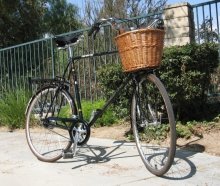
"The Plummer," as she is now configured. Fenders and chain guard to be installed sometime between now and the first rain storm in Southern California this fall

In conclusion, I would recommend the Shimano Nexus Red Band hub to people who:

  • Are not weight weenies; the hub is fairly heavy
  • Do not need thirty gears; you will be limited in both overall range and increments between gears versus a derailleur system
  • Don’t want chain gunk on their legs or pants
  • Like things to be simple and functional

Now, if you will excuse me, it is time for me to hook up the cargo trailer, strap my baby boy into the child seat, and head for Trader Joe’s. And I shall enjoy my ride tremendously. I loved my bike before I put the Nexus hub on it, but I love it even more now!