John Cutter and I go "way back," back to the early 90s, just after I stopped working at Moots Cycles. John was building custom frames in San Luis Obispo, California, where I had just started engineering school. While I look back on my framebuilding days with a great deal of nostalgia, John took a different route. He never stopped building bicycles. What's more, his designs have become increasingly interesting as his experience grows, culminating in the "Honorable Mention" he received at the 2011 Oregon Manifest Constructor's Design Challenge. The "utility bike" (and do not make the mistake of calling it a cargo bike, as I did) he built for that competition stands out as a rolling testament to the fact that an exceptional design can make a bike practical, useful, and a joy to ride.
When I saw photo's of John's Manifest bicycle, I knew I had to interview him about it. He was kind enough to answer a few questions for me.
 |
| John Cutter |
John Cutter's Introductory Statement: First
off, I would want to touch on the term "cargo". At the Oregon Manifest
there were numerous entries that I would term as being cargo bicycles,
yet the contest guidelines called for a "utility bicycle". What is a
utility bicycle? My design was driven by the fifty mile trials ride that
we were required to complete. So for me in this case the "utility
bicycle" was not going to be a cargo bicycle. It needed to be light and
efficient as well as have the capacity to carry a load. So I went with
the proven touring concept of distributing the weight and bulk of caring
cargo between the front and rear of the bicycle. I also saw the need to
be able to handle cargo that would not fit in the grocery pannier, so I
incorporated the head tube rack as I wanted another load point on the
front of the bicycle that would least effect the steering.
Q: Please give us a quick description of the important design features of your cargo bike.
A:
A:
- Multiple loading points for even cargo weight distribution.
- One-key locking system for panniers, cable lock, pump, wheels and lights.
- Center stand with integrated front wheel brace.
- Head tube mounted rack with integrated cable lock.
- Modified grocery panniers for improved weight distribution and reduced wind resistance.
- Handlebar design that blends urban and road riding positions.
- Low stand-over frame design with “up-tube” for enhanced load stress resistance.
Q: Is there any single feature that made your Manifest entry stand out from the other designs?
A: I
would say that the center stand with the front wheel brace drew the
most attention of any feature on my entry. Considering that one of the
requirements was a "Freestanding Under Load (while parked) System", I
was surprised to see that there were only a hand full of bikes that had
custom made stands. Mine was a reversed design that incorporated an
additional leg that attaches to the back of the front fender brace/low
rider rack to fix the front wheel while the bicycle is being loaded or
unloaded. When you want to take the bike off of the stand, you back up
the bicycle a few inches and the center stand retracts, catching the
front wheel brace along with it.
 |
| Cutter's entry in the 2011 Oregon Manifest Constructors Design Challenge |
A: The cargo bicycle that I constructed a few years ago (aka the "Loadie") was designed for a friend to replace his ExtraCycle. It was intended for hauling loads around town. It differs from similar rear load cargo bicycles in that it has several pairs of triangulated tubes that brace the rear rack zone of the bicycle frame. The design is not very production friendly, but it is reasonably lightweight and it rides very nicely. To my surprise, the owner has taken it on several extender tours on the pacific coast. It has also done service as a UPS holiday season delivery vehicle.
 |
| Detail of "The Loadie" |
 |
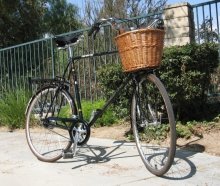
| Cutter's Amsterdam Bicycle |
Q: What design ideas are you thinking about now? Where do you see your designs going in the future?
A: The
process of designing and building the Manifest entry used all of my
spare time and resources for most of last Summer. By the time we arrived
in Portland I was very tired and was wondering how I would hold up
during the event. The interaction with the other builders was energizing
and I found that energy carrying me through the Manifest. To my
surprise, I returned home very inspired and ready to get on with the
next project. If anything, the Manifest has focused my thoughts on where
I would like to take my designs for touring bicycles. It's mostly a
matter of refinement, but it's also about having a more complete and
integrated package. If I have a signature style of bicycle, it is a 26"
wheel format touring travel coupler with integrated racks and fenders.
For the future I see myself refining this type of bicycle as well as
working with randonneuring and urban/commuter designs. In reality I
enjoy building all types of bicycles, as a builder of steel bicycle it
appears to make sense to focus on the types of bicycles that lend
themselves to a custom fitting and steel construction.
 |
| 26" Travel Coupler. The coupling points are subtle. Can you find them? |
Q: Electric-assist cargo bikes are getting a lot of attention these days,
but I was amazed at what people in China carry using only human power.
Would you consider incorporating an electric motor into your design?
If so, what performance characteristics would you hope to gain from the
electric assist?
A: This question really hits a chord. On one hand I am impressed with the performance of an electric assist and the benefits of expanding the number of people that might use a bicycle. On the other hand I look at the added weight of the motor and battery and think that it defeats the simplicity and efficiency of the bicycle. I cannot help but think that if people had lighter weight, higher quality bicycles, they might not see the need for an assist.
Q: Your bike has a head tube-mounted front rack, as opposed to a
Porteur-style rack that pivots with the handlebars and fork. Why did
you go with this design? Are you happy with the result? Have you tried
any Porteur-style cargo bikes? If so, what did you like and dislike
about them?
A: I am not a fan of porteur racks. I have built one and I really did not like giving people the option of loading so much weight onto the steering element of the bicycle. I prefer a system that as a first priority will carry grocery bags and I don't see the porter rack as being the best design for this. I opted for a head tube mounted rack on the Manifest bicycle because I wanted to have cargo capacity beyond the four grocery panniers without having a negative effect on the steering. Yes, I was happy with the result.
A: I am not a fan of porteur racks. I have built one and I really did not like giving people the option of loading so much weight onto the steering element of the bicycle. I prefer a system that as a first priority will carry grocery bags and I don't see the porter rack as being the best design for this. I opted for a head tube mounted rack on the Manifest bicycle because I wanted to have cargo capacity beyond the four grocery panniers without having a negative effect on the steering. Yes, I was happy with the result.
 |
| Cutter's one and only Porteur rack to date |
A: I have never really totally stopped building bicycles. I have been sidetracked for extended periods of time working on other projects, mainly packs, tents and other odd projects. I like the diversity of working in different mediums and occasionally combining metal and fabric work into one project. I also prefer to build bikes for people that I know or for people with a specific need, either from fit or by function requirements. I really see framebuilding as a local service to the cycling community. For now I am content to only build a few frames a year.
Q: Would you like to see your cargo bike design adopted on a large-scale
basis? If Trek came to you tomorrow and asked to license your design,
how would you respond?
A: Yes, it would be great to see some or all of my Manifest entry end up in production. I will be disappointed if a bicycle manufacture does not at least "borrow" something from the design. I would welcome the opportunity to work with a company like Trek. I see it as a chance to be exposed to all of the technology and materials that a small builder would normally not have access to use. Who knows what that might lead too?
Q: Are there any "Off-the-Shelf" bikes you think work especially well for
cargo hauling? If so, which bikes and why do you like them?
A: I really like older steel fully rigid mountain bikes as cargo bicycles. Add front and rear racks, fenders, lights and some grocery panniers and you have a reasonably inexpensive, versatile tool that can do what most people require a car to accomplish. I also like the idea of giving an older, out of service bicycle a second life.
 |
| An older steel fully rigid mountain bike, built by Cutter in 1990 |
Q: What do you like for breakfast?
A: My favorite breakfast would be cornmeal buttermilk pancakes, but I usually have oatmeal, cooked with an apple and raisins and topped with toasted almonds and maple syrup.



 Posts
Posts

