Sunday, June 29, 2008

Stephen Bilenky Speaks – Part Two

In my first article on Stephen Bilenky, which I based on conversations I had with Bilenky during two phone interviews, I shared some of his thoughts on the bicycles built by Bilenky Cycle Works (BCW) and talked a bit about the history of the company. In this installment, I will focus more on Bilenky’s future plans, his thoughts on the broader bicycle market and his ideas on how bicycles can fit into society.

When I asked him about the ideal role of bicycles in today’s transportation picture, he told me about his longtime interest in community design. He sent me a link to a 180-page document on which he was the lead author, entitled, “Community Design for Optimal Energy and Resource Utilization.” Bilenky won a National Science Foundation grant to do the research for this paper while he was a student at Pennsylvania State University. We might conclude that Bilenky has put a considerable amount of thought into this question.

He summed up his ideas by saying, “The ideal is to have a large percentage of short range, routine trips done by bicycle, so gas consumption is reduced and congestion alleviated. The challenge is bringing new cyclists into the ranks of utility cyclists and finding strategies to safely combine street traffic, mass transit, and bicycling. My urban dream development is a network of underground concourses specifically for bike travel so it’s easy and safe to commute easily and safely in all weather conditions, people powered mass transit.”

Not all of us might be thrilled at the idea of riding our bikes underground, but perhaps living in Southern California has made me forget what riding through East Coast winters is like. And you have got to respect someone who dares to “dream big.” I certainly agree with his assertion that, “If it [our transportation infrastructure] is not shaped for cycling, how are people going to surmount the barriers?”

The BCW crew in action

I asked him about his recommendations for off-the-shelf bicycles. “The Somas are nice. The Surlies are okay.” He told me he liked the purpose-built Surlies, such as the Pugsley and Big Dummy. He did opine that the Surlies “are a little heavier than they need to be.”

He also added, “Trek has a lot of decent bikes.”

In terms of used bikes, he told me, “I have a fond spot for late 70s/early 80s Japanese touring bikes. Nishikis, Fujis, Panansonics, some of the early [Asian-built] Raleighs.”

We chatted about the American framebuilders who barely make enough money to survive. I asked him if he thought it would be possible for a USA-based bicycle manufacturer to become profitable enough to pay its employees competitive wages. “There are a lot of ingredients, but a key one is the scale of operations. One to two people have such high overhead that it is hard to make stuff and sell stuff and organize stuff, etc. It would have to be very premium priced.”

Working with the good stuff...

He talked about bicycle companies such as I.F., Seven or Comotion as being big enough to potentially succeed, while not being too big to maintain manufacturing only in the USA. He pointed at Cannondale as an example of a company that outgrew the viable size limitations and had to outsource some of its production to China after experiencing severe financial problems.

Bilenky is still trying to find the right size for BCW. Currently, there are eight people working for the company, but with demand for BCW products surging, that number might need to grow in the near future. At this point in 2008, they are looking for 50% growth over last year. In the next month or so, they will start production of their biggest batch of cargo bikes ever. They have already sold three times as many cargo bikes in 2008 as they sold in all of 2007. In Europe, the devaluation of the US dollar has made American-made bicycles amazing bargains. BCW has taken advantage of this trend and has gotten good exposure in EU countries.

Additionally, the revolution in electronic communications has left bicycle messengers feeling squeezed. Since important documents can now be scanned and sent via e-mail, messengers must find new services which cannot be provided electronically. One such service is the hauling of cargo. Need to haul twenty reams of copier paper across town? A BCW cargo bike can get your paper there with aplomb.

The new BCW "Rear John" cargo bike
Photo courtesy of Moving Target Zine with some rights reserved

And there are new cargo bike models coming from BCW in the very near future! In addition to the models I mentioned in Part One of this series, BCW is also developing other alternatives. Bilenky seemed most excited about the bike he referred to as the “Rear John,” as opposed to the “Long John,” which is how he described the style of his traditional, front-loaded cargo bikes. The Rear John, also known as the “8 Freight,” features a large cargo rack behind the rider. The rack is low to the ground for stability and control. BCW introduced their first prototype of this style at the Cycle Messenger World Championships in Toronto a few weeks ago. The bike impressed many, including the bicycle messenger e-zine “Moving Target,” which called it “shockingly light.”

Bilenky is also developing a version of the “Viewpoint” tandem in which the front, recumbent rider is replaced by a cargo area. Additionally, BCW is experimenting with electric assist options for cargo hauling and a center stand which will mount to pre-installed braze-ons under the front wheel. This stand will lift the front wheel slightly off the ground and provide an extremely sturdy, stable platform when the bicycle is parked.

Bilenky Viewpoint Tandem

As we wrapped up our conversation, Bilenky talked about the preparations BCW was making for the 2008 Cirque du Cyclisme which occurred the weekend after we spoke. As he spoke of all the bicycles he was preparing as well as the presentation he was going to give, I felt that I was getting a real glimpse into this man’s life. We think of framebuilders as craftsmen or artisans. Stephen Bilenky is both of those things, and so much more. He is a scholar, a businessman, a social scientist and an ambassador for practical bicycles. He has dedicated his life to doing something he believes in and doing it well. He has both my respect and my gratitude.

Before we said goodbye, I did manage to ask him what he likes for breakfast. He told me that he was not a big breakfast eater. “I am a tea drinker, tea and cake, if I have my choice.” That works for me, as long as it gives him enough fuel to keep imagining and building the wonderful machines for which BCW has become famous.

Wednesday, June 25, 2008

Stephen Bilenky Speaks – Part One

Bicycles do not get more “real world” than those produced by Bilenky Cycle Works (BCW). Are you looking for a comfortable, efficient commuter? Look no further than BCW’s “Metro” line. Want to haul a bit more? How about A LOT more? Bilenky’s line of cargo bikes is impressive, and it is expanding dramatically! If you have special needs, if you want something uniquely suited to your riding style or your aesthetic tastes, BCW will make your custom dreams come true with a one-of-a-kind “Signature” or “Artisan” model designed and built especially for you. And while BCW cannot match the prices of mass-produced bicycles from China, with frames starting at $950, even the prices are real-world enough for me.

I have admired the bicycles made by BCW for many years, so Stephen Bilenky was one of the first people I contacted for an interview when I started “Cycloculture.” He graciously agreed, and I e-mailed him a list of interview questions. Most folks simply send me back a list of answers, which I print in my blog. Bilenky, on the other hand, pondered the questions for a few weeks then worked with me to arrange two telephone interviews so we could discuss his answers in depth. Throughout the process, he struck me as an intelligent, thoughtful man, in the sense that he carefully considered every question and gave me real, in-depth answers, not the “talking points” one sometimes gets from a publicist who is more interested in spreading hype than providing information (not that I have talked to any PR drones for Cycloculture as of yet). As a result, these two articles are a bit more conversational, perhaps a bit more personal. Enjoy.

Stephen Bilenky

When I asked Bilenky what he had learned in his three-plus decades building bicycles, he started off by saying, “Fillet braze quickly and shapely.” He went on to talk about the importance of both solving and avoiding fabrication problems. “Learn how to do the craft well. Learn how to fix mistakes. Learn how to avoid mistakes.”

He stressed the importance of using machine tools properly, and I knew what he meant. Almost anyone can grab a file and do a “good enough” job of shaping tubing after a bit of practice, but in order to perform these operations quickly, accurately and in large quantities, machine tools are required. Currently BCW uses only standard mills, lathes, etc. They contract out some work when using automated CNC machines makes more sense. Bilenky also stressed the importance of proper metal finishing. You need the right expertise and the right equipment for preparing surfaces for plating, polishing, painting, etc.

Members of the BCW crew that brings these bikes to life

He went on to talk about the nuts and bolts of running a design/manufacturing business. Computers are critical not only to design bicycles and communicate custom designs to customers, but also for running a business in general. He discussed the difficulties involved with coordinating multiple projects. Every day, he must juggle tasks such as building frames, granting interviews, training employees, preparing for various shows and events, and a list of other responsibilities. Over the years, he has learned to balance these jobs and keep BCW running as smoothly as possible. Critically linked to this balance is the art of getting along with people. Bilenky talked about the importance of working well with customers, suppliers and employees.

At that point, I got into more specific details of BCW-built bicycles. On the BCW website, Bilenky calls the Metro 5, a bicycle Bilenky originally built under the “Sterling” brand name, “the ideal bike.” I asked him why. “It’s light, strong, elegant, simple, comfortable and fun to ride for any kind of practical or moderate distance recreational riding. Plus to me it’s the perfected ‘English Racer’ that I never had when I was younger.”

A Bilenky Metro Luxe 14B

He went on to talk about a Columbia “Something Deluxe” that he had when he was a boy. He loved that Columbia, but had a hard time finding tires for it, so he bought a pair of 26X1 3/8” rims and laced his first set of wheels on the Columbia’s hubs. The shop owner who sold him the rims was impressed enough to hire Bilenky when his mom applied for a job on his behalf a few weeks later. He’s been thoroughly immersed in the bicycle world ever since.

Bilenky told me that BCW manufacturing consists of a good mix between production bikes and one-offs. BCW “Eco” series frames start at $950. The “Signature” series frames top out at $2500. I asked Bilenky to walk me through the differences. “We try to cater to a spectrum of buyers that goes from basic steel handbuilt steel frames to a one of a kind commission. Our different price levels represent a combination of design and finish options, material, construction method, and fork. The $950 that you mention is a tig-welded track frame, no braze-ons, no fork included, built to our stock plans and tubing. As we go up to the Deluxe level there is more customer input and customization available - forks go from production to handbuilt, material is upscaled, lugged and fillet brazed construction is available. The signature represents a finely detailed and hand finished sculpture in motion, fine tuned to the requirements of each customer.”

A single speed, lugged Bilenky cyclo-cross bike

Recently, BCW introduced the “Artisan” line, which is a step up from the “Signature” series. Frame prices start at “$3500+. Their website describes the “Artisan” frames as “Our ‘sculpture-in-motion,’ features one-of-a-kind metal work that distinguishes each frame as a unique creation. Material specifications are determined by the riders' measurements, style, and intended use. Material is chosen from the best the world has to offer - USA, Italian, and British steels. A frameset of heirloom quality.”

I went on to ask Bilenky about my favorite element of BCW production, their cargo bikes. He told me that they had been building the cargo bikes for ten years, and that their cargo bike business was booming. They are dramatically increasing their cargo bike offerings, with models including a shorter wheelbase version which still has a steering linkage, a rear-loader with a big cargo box in back, and a front-loader with a 40cc two-stroke engine.

A short wheelbase Bilenky front loader

He is also “contemplating” manufacturing pre-made attachments for the cargo bikes, such as standard boxes, lockboxes, waterproof containers, etc. “We need to be in the 'solutions business,'” he told me, “Is that [cargo bike accessories] going to be the next big thing?”

Bilenky cargo bike with large front box

Bilenky and I chatted for quite a lot longer. In the second and final article on this interview, I will talk about some of BCW’s future plans, new models they will be introducing soon, Bilenky’s thoughts on the role of the bicycle in today’s transportation picture, and, of course, what he likes for breakfast. Stay tuned.

Read the second half of this article here.

Monday, June 9, 2008

Electric Bicycles, China-Style

I recently wrote an article on the electric bicycle phenomenon in China for EVWorld.com. There are already millions of e-bikes there, and they seem to be getting more popular all the time. At this point, the default commuter vehicle in cities such as Shanghai is an e-bike. Cycling does not get more "real world" than that.

See the full story here.

Electric bicycle rush hour in Shanghai

Sunday, June 8, 2008

Fifteen Days in the Belly of the Beast

Over at the Kogswell Owners Group (KOG), there was a recent discussion about the “Yo Eddy” fork, manufactured by the late, great Fat City Cycles.
It was generally agreed that this is a very good bicycle fork design. It was also agreed that this was a difficult fork to manufacture. There are many parts which require complex metal-forming and precise alignment before welding or brazing. Still, Kogswell owner Matthew Grimm is moving forward with producing this fork for a version of the Porteur/Randonneur (P/R). This is great news! Many people were surprised that Kogswell could manufacture this fork within the budget of the reasonably priced bicycles they produce.
A "Yo Eddy"-style fork by Planet X (no relation to Factory X)
Now let me tell you about a factory in China I recently visited. Let’s call it Factory X. Factory X builds Yo Eddy-style forks in a mass-production environment. This factory has well-designed fixtures that hold the tight alignments required. From what I could see, I estimate that 75% of the welds from this manufacturer would have passed inspection at Fat City. The other 25% would still have been an improvement over what consumers saw on Diamond Backs and Univegas from the 1980s.
Factory X builds these forks for bicycles which they sell directly to big-box retailers. The bicycle which uses these forks sells for around $80 at Walmart. Oh, and they make more than 2000 of them every day, six days each week, throughout the year.
A "Next" brand bicycle, available at Walmart and built by "Factory X," with a"Yo Eddy"-style fork cleverly disguised to look like a suspension fork
Don’t get me wrong here. The P/R is vastly superior to any bicycle produced in this factory. At $600 for frame, fork, fenders and assorted goodies, the P/R is one of the most amazing bargains in the bicycle universe, and the Yo Eddy-style fork will make it even better. Kogswell’s fork will likely use custom drawn cro-moly tubing with very nice droupouts. The fork from Factory X, in sharp contrast, is made from high-tensile steel and the dropouts are stamped into the same pieces of tubing which form the fork blades.
That said, Factory X builds this fork, and all of their other products, to extremely high quality standards, given their financial constraints and the jaw-droppingly large quantities they build. They employ dozens each of highly trained welders, machinists and assemblers, most of whom could walk into an operation of similar caliber to Fat City and immediately start building products to the highest quality standards imaginable. Factory X is spread over four enormous buildings co-located on one industrial campus. It produces more than 900,000 bicycles per year presently, but the owner of the factory assured me that they could easily boost production to 1.3 million units using their current resources. Of course, if they “tap out” their current capacity, they have many, many acres on their lot to build more facilities.
During my business trip, I visited eleven bicycle factories in China and Taiwan. Factory X was the second largest factory I saw. The largest factory was a self-contained citadel as well as a manufacturing center. Its total manufacturing capacity greatly exceeded that of Factory X. It could form steel or aluminum into nearly any desired shape, then heat treat the material any way imaginable after welding. Many of the workers lived in on-site dormitories.
"Factory X," located near Nanjing, China
On the other side of the spectrum, I was dragged through a small factory producing the cheesy cruiser-style bicycles one frequently sees advertised on Craigslist. I was visiting a components maker, and I suppose he owed the factory owner a favor, so he offered me up as a potential buyer from a big American company. I was not interested in anything that factory built. However, when I compare this relatively modest manufacturing plant to my tour of Huffy HQ in Ohio back in 1998, the awesome scope of Chinese bicycle manufacturing becomes even more clear. The most humble factory I saw on my trip produced goods of far higher quality than anything Huffy produced ten years ago.
In between these two extremes, I saw everything from well-established factories building high-end equipment for some of the biggest names in the bike business to small companies producing less than one thousand specialty bicycles each month. I did not see any sweat shops. I got the distinct feeling that, because of the manufacturing boom occurring in China, most of the workers were able to demand fairly good working conditions. If they did not get them at one factory, there were plenty of other factories hiring.

The Shanghai skyline, the heart of China's economic revolution
Perhaps I was imagining it, but I also thought I saw a sense of cooperation and mutual purpose amongst the workers in the Chinese factories that was distinctly lacking in various American factories I have visited. In a former professional life, I spent a fair amount of time in GM and Ford plants. The union workers I encountered in these plants seemed determined to make as much money as possible, a trait they shared with their Chinese counterparts I observed on my trip. However, the American union workers also seemed determined to return as little work as possible for the money they were paid. This contrasted sharply to the attitude of the Chinese workers, who seemed to understand that when the company made more money, they could make more money. Workers and management seemed united in a capitalistic profit frenzy which resulted in efficient workers being given what they needed to get their jobs done as well and quickly as possible.
I was also surprised by the level of technological sophistication that complimented the “good, old fashioned” manufacturing fundamentals I saw at the factories in China. The well trained, professional employees were supplemented by rows of robotic welders, CNC machines, automated test equipment and other technologically sophisticated equipment which were set up, monitored and maintained by many experts in the various technological fields. The efficient work-flow patterns were made even better by elaborate conveyor systems which took parts wherever they needed to go. In addition to excellent execution of basic manufacturing techniques, certain factories employed “cutting edge” processes as well, such as aluminum brazing. I saw a combination of old and new. These factories did whatever made sense to build the best products at the lowest prices.
In China, they know how to build bikes for the real world
It is difficult to express in words how seeing these remarkable manufacturing centers made me feel. I was filled with a combination of awe, fear and hopefulness. I was awed to see such amazing manufacturing abilities applied on such huge scales (not to mention small and mid-sized scales). I was fearful that China’s incredible manufacturing might will allow them to increasingly “eat our lunch,” economically speaking, over the next several decades. While Americans are working in circles, feeding our “service economy,” China is building not only material wealth, but the infrastructure required to build exponentially more such wealth in the near future.
But I am also filled with hope. There is nothing inherently superior about China’s ability to build, staff and operate factories. Indeed, they have taken many of their industrial cues from the USA. American workers have proven that, given the right incentives, they can be as enthusiastic and efficient as anyone on this planet. While it is true that the world economy currently favors goods made in China, this situation will not last forever. Economic balance will be achieved at some point in the future. When it does, and when oil prices and other issues force us to replace our cars with bicycles, I look forward to building millions of them from a state-of-the art manufacturing center near my home.

Tuesday, April 15, 2008

Civil Discourse with Surly's Andy Corson

Surly has been quietly revolutionizing the bicycle world since 1999. Strangely, they have been doing this revolutionizing through the use of practical frame designs and that exotic frame material, steel. From street bikes to off-road bikes to bikes that do anything and everything, Surly offers something for everyone who views a bicycle as more than a toy, a status symbol or a piece of exercise equipment.

A few years back, I e-mailed Surly. I laid out all the economic reasons why they should build a 68cm road frame. I stated my case in an organized manner, then I begged, pleaded, groveled, etc. Shortly thereafter, I got an e-mail back from Surly’s Andy Corson. He complimented me on the structure of my request and politely said “No.”

We had such a nice dialogue around that issue that I have pinged Andy every now and then since our original conversation, asking him questions on the bicycle industry and generally getting his take on various bicycle-oriented situations. He has always been prompt, helpful and insightful, so I figured he might have some interesting things to say for Cycloculture.

Andy Corson, practicing what he preaches

Q: What is your official title at Surly?

A: Marketing “Manager.” That’s with the quote marks, although you could place them on either word for equal irony.

Q: Forget, for the moment, about marketability and other mundane concerns. If you could design and produce any bike you wanted to, what would it look like? Ride like? Be like?

A: Honestly, it wouldn’t be that much different from many Surly models. That may sound corny, but I started working for Surly in large part because their designs and approach made more sense to me than most of the other stuff that was and still is out there. I like fenders and big tires. I like steel for a lot of reasons, not the least of which is the ride quality. And I like versatile designs that allow some significant personalization. Although not everyone will build a unique frankenbike, with a Surly the option is there.

Q: There seems to be a movement toward front-loaded carriers on bicycles these days. Any thoughts on that trend?

A: I assume you’re talking about platforms or front baskets, as opposed to front ‘low rider’ racks and panniers. Most front carriers are add-ons, and they ride crappy when you throw any kind of weight on since they’re generally connected to the bar and fork, and ride high. Some companies alter the geometry of the frame to help accommodate compromised steering with this sort of front platform. Others connect the basket or platform to the frame instead of the bar and fork. I don’t have anything against front carriers, but I don’t use them either. With so many other options that work so well without a specific frame, I don’t find them compellingly useful.

However, front loaders are part of a larger trend that seems to be growing, a trend of people exploring options and investing in technology to haul stuff by pedal power. From handlebar bags to entire cargo-dedicated bikes and frames, I can’t remember a time when there was such a range of offerings for hauling stuff on your bike. And that is the real point I’m trying to make here: it doesn’t really matter if I personally like front racks, because each option has it’s pros and cons and what works for me may not for someone else. What matters is that there are options and an awareness of the possibility of using one’s bike for more than a Sunday cruise.

Are dérailleurs for wusses? You decide...

Q: What's the main difference between a Surly and a custom-made steel frame?

A: Custom stuff is custom. Surly produces some very fine quality frames but they are production frames. When you buy a Surly frame or bike you don’t get a lighter or heavier tubeset to match your weight and riding style. You don’t get geometry designed just for you. You don’t get to pick your paint color, or have your name put on the top tube. There can be some real advantages to buying custom, especially if you don’t fit standard frames, or if you’re an advanced-enough rider to notice and benefit from custom spec’d tubing and geometry. Or if you want a lugged frame.

Most people are not going to benefit in any real way from a custom frame, however, as a lot of the benefits are relatively small in the larger scope of what makes a frame good or bad for you. Buying a custom frame is partly about getting the perfect bike to ride and partly about getting the perfect bike to show off. Both are legitimate reasons I suppose.

Q: Any chance Surly could ever build bikes in the USA? Or is that just not possible given the economic reality of today's global economy?

A: It is doubtful. We’ve had stuff produced in the U.S., and have checked domestic manufacturing pricing on many items. We’ve run into lots of issues and plan to stay with our manufacturers in Taiwan. The majority of the world’s bicycle frames and parts are produced here, and having that center of infrastructure lowers pricing on everything quite a bit. A lot of people want domestically produced stuff but simply are not willing to pay for it.

However, it isn’t just pricing. We’re happy with the quality of the work our builders put out. In fact we feel it’s on par with, and in some cases better than, frames costing quite a bit more. We work closely with our agent and manufacturers. This allows us great control over the process and quality of the stuff being produced. It also means we personally know not just the managers of these firms, but the employees as well, the people welding the frames. We see where and how they work.

When we have investigated domestic manufacturing, we have found the same obstacles repeatedly: pricing is much higher, quality is no better and sometimes worse, supply chains are spottier. There are a few places that might be able to do what we want, but I doubt we could keep our prices even close to what they are, and that would fundamentally change the sort of company we are and the stuff we could offer.

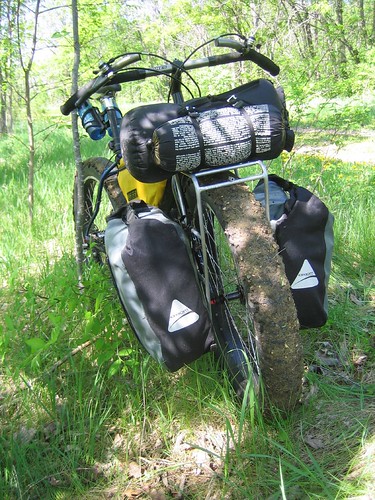
Could there possibly be anything cooler than a muddy Pugsley?

Q: Do you commute by bike or by car (or by something else)?

A: Both. I drive sometimes, I ride sometimes. I’m o.k. with having and using a car, just not for everything. I’ve noticed that there are people who will try to make me feel guilty for this, but outside of the insulated world of bike geekery, I think it is representative of a challenge most people are faced with. The fact is that most people are not going to completely give up their cars because it is impractical. Using a car isn’t fundamentally bad, but using it for everything is equally impractical.

Q: Is the bicycle a practical vehicle in cold, snowy climes such as Minnesota?

A: Sure. A bike is arguably better in an urban winter environment, since you can avoid a lot of the traffic tangles that sprout up when the weather gets bad. Cars can’t.

Snow is an issue no matter what. You have to have skills to safely drive a car on snow and ice, and you have to have skills on a bike too. I find riding in winter less stressful than driving. Cars do not require the level of confidence that bikes do, though. It can be a hard argument convincing people they can ride in winter. But then I look out the window and see the guy who rides past my house every day on a cheap walmart-type bike, wearing regular clothes. No studded tires, no wind shell, no special gloves. ‘Nuff said.

Q: Can you give me an idea of Surly's basic design and/or corporate philosophy in a few sentences?

A: We design and produce no bullshit bike stuff that works like it is supposed to, that’s durable, practical, and versatile. Our stuff is meant to be used every day. We don’t do anything just because someone else is doing it, whether it’s a business decision or a product.

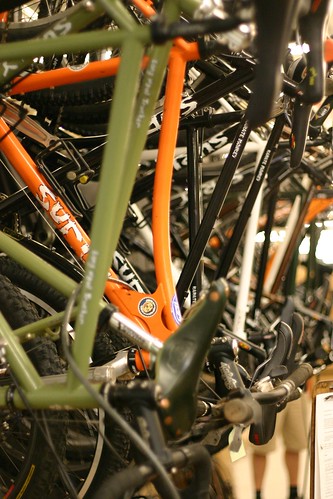
A dizzying array of wonderful bikes

Q: Does Surly have anything new and exciting coming out in the near future?

A: Yes!

(Editor’s Note: $%&*#@!!! Guess Cycloculture is going to have to grow a bit before we get scoops like this…)

Q: Do you have something against big dummies? Keep in mind that I am 6'6", and I know where you work.

A: Why, because we don’t produce an XXL Big Dummy frame? Maybe you could use one as a unicycle.

Q: What else would you like to say?

A: Nothing for me, thanks. I’m full.

Q: What do you like for breakfast?

A: This morning I had raisin bran with rice milk. Pretty good, but a meatball and bacon sandwich would be better.

Wednesday, April 9, 2008

An Interview With David Herlihy, Author of "Bicycle: The History"

David Herlihy's book, Bicycle: The History, was the first and only book on bicycles which made it to the most prominent display stand at my local Barnes and Noble. Published in 2004, it has been a stunning success, bringing the history of bicycles to tens of thousands of people in several different languages. The book is rich and colorful, both in its photos and its words.

I met David while I was in college in the 1980s. He was making a bit of extra cash by buying beautiful, slightly used road bikes in Italy (DeRosas, Cinellis, Tommasinis and the like) and then selling them at remarkably affordable prices to cyclists in the USA. This allowed him to indulge his love of travel, play with wonderful bicycles, and bring joy to people on both sides of the Atlantic. Come to think of it, his books on cycling do pretty much the same things...

David V. Herlihy, Author and Bicycle Lover

Q: Bicycle: The History was a huge success. How has this success changed your life?

A: Thanks, Forbes. “Huge” is a relative (and very flattering) term. But if I may brag a bit, since it came out in fall 2004, Bicycle has sold over 20,000 copies, mostly hard covers. That’s a pretty giddy figure for a book of this nature, published by an academic press. I’m sure it’s a lot more than even Yale had anticipated. From what I hear, it’s now one of their all-time bestsellers (there are even editions out in Russian and Korean).

All this is highly gratifying, as was all the attention it received in the press, including reviews in prestigious publications like The Economist and The New York Times Review of Books (I have to credit my brilliant publicist, Brenda King, for engineering much of that). Most were quite favorable and easy to digest (a few were less satisfying, but I managed to get over them pretty quickly).

The Cover of Herlihy's 2004 Book, Bicycle: The History

(Published by Yale University Press)

And, yes, I relished my fifteen minutes of fame. It was great fun touring and promoting my book, even if I had to cover my own expenses for the most part. I enjoyed giving slide lectures and signing books, and meeting cycling enthusiasts of all sorts. One of my most memorable moments was at a bike show in Edison, New Jersey, where I had a table. After one guy confirmed that I was in fact the author, he kind of lost it. He had his picture taken with me using his cell phone. I felt like a rock star.

Getting back to reality a bit, I can’t say that the book has radically changed my life or lifestyle, at least not yet. But it has been a very positive experience and I think it has opened up new artistic possibilities.

For starters, it was a great relief and satisfaction to finally turn a decade plus of research into something concrete that could give me some recognition and actually generate a little revenue to keep body and soul together (not to mention helping to pay for all that research, which included multiple trips to Europe. Not that I’m asking for sympathy, mind you!) And I must say, in my defense, that much of my best material surfaced toward the end of my inquiry. Had I published the book even a few years earlier, it simply would not have been as colorful or as rich.

Not only was I able to share many interesting discoveries, I also got to air some deeply held convictions. I think there are a lot of misconceptions out there about bicycle history, especially with regard to the invention and early development. The kick-propelled Draisine of 1817, in particular, was not a bicycle per se and, as it turned out, it did not lead directly to the original bicycles of the 1860s (though it was arguably the primary inspiration). I’ve also concluded that the Scottish priority claims arising during the boom of the late 19th century are dubious at best. And of course the great contribution of Pierre Lallement, the original bicycle patentee, has long been overshadowed by the Michaux name, which likewise shrouded the role of the Oliviers, the true industrial pioneers.

In some sense it may be a losing battle to insist on all these points—myths are stubborn things. But at least now I’ve spoken my peace and I can move on to other exciting projects with a little more financial stability and a little more credibility and clout.

Q: What are some other projects you are working on?

A: Over the past few years, I’ve continued to give lectures here and there for various cycling groups and educational programs. Next month, for example, I’ll participate in a panel discussion at the unveiling of the Major Taylor memorial in Worcester. And on May 24 I’ll give a talk at the Museum of the City of New York. We’re starting to talk about putting together an exhibition on the history of cycling in New York, in conjunction with—appropriately enough—Bike New York, (sponsors of the annual 5 boro ride that draws 30,000 cyclists).

The Cover of Paris-Roubaix:A Journey through Hell

(Published by VeloPress)

I’ve also done several projects with Velopress of late. I translated a great book on the history of Paris Roubaix by the editors of l’Equipe. It’s a beautiful coffee-table book with fabulous photos. And I have to say the text is also quite engaging! I also translated a book on the Alpe d’Huez stage by my good friend Jean-Paul Vespini. It’s coming out in a few weeks and I’m really looking forward to pawing through it. I just saw some proofs and the photos are eye-popping. Plus the author did a great job covering the history of this phenomenon not only as a decisive stage in the Tour but also as a colorful cultural rendez-vous.

The Cover of The Tour is Won on the Alpe

(Published by VeloPress)

And I just signed a contract with Houghton Mifflin to write a book on Frank Lenz. Researching his fascinating but forgotten story has been my focus for the past few years and will continue to be so into the foreseeable future.

To summarize: in May 1892, on the cusp of the bicycle boom, Lenz set off from his hometown of Pittsburgh to circle the globe on the latest “safety” bicycle with inflatable tires. Two years into his journey, after crossing North America, Japan, China, Burma, India, and Persia, he mysteriously vanished. Investigators later traced him past the Persian border, into Turkey and the foreboding land of the Kurds. Ironically, Outing magazine, Lenz’s sponsor, sent another American “globe girdler,” William Sachtleben, to find Lenz dead or alive. It turned out to be a very bad time to visit Turkey, with massacres of Armenians unfolding before his own eyes. Sachtleben himself was lucky to return home alive. He firmly believed he had resolved the mystery, but his failure to find Lenz’s bones or bicycle, or to secure satisfactory convictions for murder, left the matter festering. Lenz’s heartbroken mom eventually received an indemnity from the Turkish government, but his legacy quickly faded in the 20th century as the public lost interest in the bicycle. I’ll discuss Lenz’s background and personality, and what motivated him to go off on this dangerous adventure. I’ll also trace the trip in detail, putting a positive spin on it. Finally, I’ll take a hard look at Sachtleben’s findings and try to figure out what really happened to poor Lenz.

Q: Do you still have time to ride your bike?

A: I confess that I have the time in theory. And the bikes. But I don’t do as much recreational riding as I should (and it shows, I’m afraid!). Lately, I’ve mostly done organized rides from time to time. Bike New York has become a tradition every May, and it’s a blast. I also did part of Cycle Oregon a few years back, and a few other group rides since then. But mostly I cycle in the Boston area, just to get around. I just acquired a new Bike Friday, which I still need to assemble. I expect to ride a lot more after that. I would like to get back into road riding, too. In theory I could use one of my old Italian racers, but I would love to get something more contemporary. And maybe a mountain bike too. Got to get this book done first, though, so I have some discretionary funds.

Q: Your book made it clear that you love bicycles. Do you love any one type of bicycle more than others? Is there a particular kind of bicycle that is nearest and dearest to your heart?

A: I’d have to say the classic light weight road bike with skinny tires is still my favorite. But I’m also into the idea of bicycles as basic transportation, especially in these times. The Bike Friday offers a great combination off both riding pleasure and practicality. I can’t really speak to mountain biking as I’ve never really indulged in that sport. But I have friends who are really into it, and I know someday I should really give it a try.

An Illustration from Bicycle: The History

Q: You used to bring wonderful used road bikes back from Italy. Do you still have connections over there?

A: In theory, yes, though I haven’t bought any bikes over there in quite some time. I spent a number of years in Italy growing up, and I still go at least once a year. So I’m still fluent in the language. There was a time when I went regularly to the Milan trade show. And I got the chance to meet and interview some legendary names like Cino Cinelli and Valentino Campagnolo, when I wrote for Bicycle Guide. But I haven’t kept up my contacts in the bike industry, I’m afraid. Lately when I’ve gone over it’s been more researching, dining, touring, and socializing. In that order, of course.

Q: Have bicycles gotten better through their history? Or were the old bicycle designs more practical than the designs for new bicycles?

A: Well you can certainly make the case that the bicycle progressed in the second half of the 19th century, becoming increasingly roadworthy and hence practical in that sense. The original “boneshaker” of the 1860s was a noble idea but one in desperate need of material improvement. You could argue that its replacement, the fleet but precarious high wheeler, took the concept in the wrong direction, that is, away from practicality. After all, the original bicycle caused an international sensation precisely because it was supposed to serve as a practical “people’s nag.” And the high-wheeler, of course, became an expensive toy for athletic males. But the high-wheeler and its racing culture did establish much of the basic technology necessary to make roadworthy bicycles, including tubular steel frames, wire wheels, rubber tires, and ball bearings. And it did set the stage for the great bicycle boom, when the bicycle truly showed the world all its marvelous potential, utilitarian and recreational. The chain-driven “safety” bicycle with inflatable tires was, in essence, the culmination of an age-old dream: a valid human-powered vehicle that was both pleasurable and practical.

You can even carry the notion of “better” bicycles well into the 20th century (in terms of more practical design, not to mention vastly more affordable price-tags). As impressive as boom-era bicycles were, they were generally too light for everyday use, with their relatively fragile frames and wheels. And they lacked basic amenities such as freewheels and a selection of gears on the fly. By the middle of the century the market offered much more practical—as in versatile and robust—bicycles. But they weren’t necessarily much fun to ride. Many were intolerably heavy and sluggish by today’s standards. Even as late as the 1970s you pretty much had to buy a fancy (but not so practical) ten-speed to get any real thrill from riding.

Another Illustration from Bicycle: The History

So from the consumer’s perspective, although bicycle technology was already highly developed and varied by the mid-20th century, there was a still a need for useful innovations that could enhance riding pleasure while offering greater roaming possibilities. The introduction of mountain biking helped establish useful and attractive new features such as indexed shifting, greater gear range, and more robust frames, wheels, and tires to enable off-road riding. Much of this technology had already been introduced in one form or another, but the Mountain Bike created a compelling new package that for once transcended the marketing hype. It not only helped lure millions of adults back to recreational cycling, it opened the door to a much greater variety of bikes that are both fun to ride and practical.

Today, though, I think the notion of “better” bikes on the way is getting fuzzier. There’s already so much good technology out there, and so many different models to chose from, the trick is really to define your riding style, ambitions, and budget, and then make an intelligent selection based on those criteria. In many situations, some relatively basic and “old-fashioned” models will do just fine, thank you. Some would even say there’s already an abundance of underutilized bike technology out there, like recumbents, which claim superior speed and comfort. So while you never want to close the door entirely on progress, the truth is cyclists have never had it better and finding the “right” bike for a given situation has never been easier.

Q: How can we, as a society, replace cars with bicycles?

A: Well, I think we have to start with realistic goals. The humble bicycle cannot solve all our transportation needs, and it is not a practical transportation alternative in many situations, particularly in rural locations. That said, the bicycle is great resource, especially in congested cities where traffic and pollution are major issues. And it is one that is still woefully underutilized, and least in many American cities. So there is the possibility—some would even say necessity—to encourage greater reliance on the bicycle, at least in urban settings. And few would argue that that is a highly desirable goal from a number of respects. The less we rely on cars within the city, and the more we cycle, the happier and healthier we’ll become.

As to how to bring this about, I think it’s sort of a carrot and stick problem. On the one hand, you want better facilities, such as bike lanes, parking stations, and bicycle-friendly transportation systems. On other hand, you might need to take certain steps to get people off their duffs and out of their cars. London, for example, imposes fees to drive into city limits.

A good example of dangling a carrot may be found in Paris. It has recently launched a highly successful bike rental system with depots scattered across the city. The cost is minimal and you pay by credit card. I hear all sorts of people use it, including many who never used to cycle. And it may be that urbanites will find increasing incentives to cycle, even without the prospect of punitive measures. That may be the silver lining to rising fuel costs.

Still Another Illustration from Bicycle: The History

Q: What do you like for breakfast?

A: I’m not really a big breakfast person, though I do need plenty of coffee in the morning and an occasional glass of orange juice. When I’m home, I’m often too lazy to prepare anything for myself. If there’s cold cereal around and the milk hasn’t gone bad I might have that. Or if it’s a weekend I might make an omelet. If I’m a guest somewhere, that’s different. When I’m visiting my brother in New York, if it’s a Saturday, he makes tasty waffles from scratch. If it’s cold out and my host offers me oatmeal, I’ll probably have that. Don’t tell my mom, but I actually kind of like it. I used to have it all the time, though, as a kid growing up in Madison, and I kind of burned out on it.

If I’m in Europe I usually do the pastry and café crème or cappuccino thing. In France I’ll take a fresh croissant au beurre. In Italy I’ll usually go for a rice “budino.” If I’m traveling in the US on a research mission, I often go for a big breakfast so I can skip lunch. I’ve had more than my share of Egg Mcmuffins (the inventor recently died, by the way). I’ve even had their pancakes, and I was recently induced in Erie to try a steak with bagel thing. Once was enough. If time and budget permit, I’ll upgrade to a Denny’s, IHOP or Waffle House depending on what’s available. But I much prefer eating breakfast at an authentic greasy-spoon. That’s still one of the best bargains out there.

Monday, March 31, 2008

How to Buy A Bicycle on Craigslist.org

No matter what kind of bicycle you want, chances are good that you can find it on craigslist.org. From expensive bikes at “less expensive” prices to practical, functional bicycles for less than $100, craigslist offers a dizzying array of possibilities. There are many great deals to be found. However, buyers must also beware of scammers and junk-sellers looking for the unsuspecting sucker.


Finding and Buying the Right Bike


This article focuses on helping folks find a good, reliable commuter bicycle for a reasonable price. A good commuter can take lots of forms. All the “cool kids” are riding road bikes these days, and road bikes can make great commuters. However, all terrain bikes (ATBs) make great commuters as well, and since they are not currently in fashion, they tend to cost less. Generally speaking, ATBs offer a more upright seating position which is comfortable and provides for a good, heads-up viewpoint. They also have very durable wheels, frames and components.

Road bikes, on the other hand, are more efficient and faster. The “drop” handlebars on road bikes provide multiple hand positions, which can help riders avoid wrist, hand and shoulder pain over long rides. Road bikes designed purely for racing tend to be too fragile for most commuting duties, but most road bikes were designed to be sturdy enough for “real world” use. These benefits make road bikes a great choice for commutes longer than 10 miles or so, while ATBs shine on shorter rides. “Hybrids” or “City Bikes” provide another option. With sitting position similar to that of an ATB and wheels which are halfway between road and ATB wheels, these bikes provide many of advantages of an ATB without as much of an efficiency penalty.

For most commuters, the overall quality of a bicycle is more important than the style. An ATB with narrow, high pressure tires and “bar end” handlebar extensions will feel a lot like a road bike and give the rider multiple hand positions. A road bike with fatter tires and sturdy rims will be plenty rugged for the streets of most urban areas. A buyer who is willing to consider ATBs, hybrids and road bikes is likely to get the best deal on a great bike.

The quality of a bicycle is linked to the brand of the bicycle. The best brands have always been sold through bicycle shops. Companies such as Trek, Specialized and Cannondale have produced wonderful bikes for decades, and they tend to hold their value very well. Other brands also produce (or produced) great bikes but are not as well known. Old bikes from Univega, Nishiki, Scott, GT, Kona and Bridgestone all started life as high-quality products, but are often sold at bargain-basement prices. There are many other good brands as well. If you see a bike that looks intriguing, do a web search on the brand name to see what the experts say. Or better yet, find an expert and ask him/her about the bike.

Bikes originally sold by department stores should be avoided by people looking for reliable transportation. Brands to avoid in this category include Huffy, Murray, Magna and Pacific. Most Free Spirit brand bikes from Sears also fall into this category.

Schwinn has made some good bikes, some great bikes, and some horrid bikes. Schwinns built up until the mid-1970s tend to be heavy, but bomb-proof. Schwinns from the mid-1970s through the 1990s were good quality machines. Schwinns made in the last few years were sold at big box stores such as Walmart and should be avoided. Fortunately, Schwinns have a large and enthusiastic fan base, so there is a wealth of information on the nameplate available on the web. If you find a Schwinn you like, do a web search on the model name and see what comes up.

Quality sometimes depends on price as well. Expect to pay at least $50 for a decent fixer upper which will require another $50 to $150 in parts and repair work. For $100 to $250, a buyer can purchase a good, solid bike which will not require many new parts, but will probably need a good tune up. If you have more than $250 available for a used bike, you can get a wonderful, high-performance machine or a collectable classic, or both! Once again, the bicycle may need a professional tune up, but after that the bicycle should be a pure joy to ride.

Another important consideration is the size of the bicycle’s frame. No matter how good a bicycle is on paper, if it does not fit you, riding it will be a miserable experience. When looking at bicycles, stand over the “top tube,” the bar the connects the seat area to the handlebar area, with both feet flat on the ground. On a road bike, you should have about an inch of clearance to the tube. On a mountain bike, you should have between two and four inches of clearance. While the length of your upper body relative to your legs can effect the frame size you should choose, the general frame sizes people of average build should ride are listed in the table, below. To find the frame size, measure from the middle of the crankset (the parts that connect the pedals to the frame) to the top of the top tube.

When looking at any type of bike, check a few important areas:

• Make sure that the frame and fork are not bent or heavily dented
• Look for rust on the chain, spokes and frame
• Lift the bike up and spin both wheels. The rims should not wobble from side to side or jump up and down
• Ride the bike and make sure that the gears shift well and the brakes stop you in a controlled manner
• Check the tires to see if they are dried and cracked

If you see damage to the frame or fork, walk away.  If you find problems in any of the other areas listed above, you can fix them, but it will cost you. Cleaning and lubing a mildly rusty chain or installing new inner tubes is easy and inexpensive. On the other hand, replacing an entire wheel’s worth of rusted spokes or buying a high-end derailleur can cost more than a cheap used bike. Use your judgment, but understand that a few repairs can add up to a substantial amount of money. If there is something about the bike that makes it impossible to test ride, you should probably walk away.

Avoiding Scams and Ripoffs
Unfortunately, craigslist attracts unscrupulous folks who are looking to profit from other people’s ignorance. Use common sense at all times. If a deal seems too good to be true, it probably is. When shopping for a bicycle, follow these simple guidelines:

• The more superlatives in the ad title, the worse the deal. Phrases like “Won’t Last!” “Incredible Deal!” and “Ultra High Performance Olympic Quality Bike for Less Than $500!” are all signs of trouble. When someone tries to hype a bicycle so much, it almost always means the seller is looking for an ignorant buyer.

• If you see the same ad popping up over and over again, ignore it. Craigslist only allows a person to post the same ad once each week. If the same ad keeps popping up every day, the seller is cheating the system to get more exposure. If the bicycle were worth the asking price, it would sell without multiple postings.

• Do not buy new bicycles from businesses. Craigslist was created for individuals to sell used stuff to other individuals. There are rules in place to keep businesses sequestered in one area of craigslist, where they pay for their ads. Any ads showing lots of new bikes for sale in the “Bicycles for Sale” section were posted by sleazy sellers. Most such ads are for beach cruisers costing less than $100. These bicycles are junk.

• If you send questions to a seller and don’t get straight answers or get a response that pressures you to buy right away, look for another bicycle. There are lots and lots of bikes for sale on craigslist. If you miss out on one, another great one will pop up in a little while.

If you see a bike that looks interesting, but you are not sure if it is the right bicycle for you, ask an expert. Most people have at least one friend who is a bike nut. If you do not, you can walk into a bike shop and ask an employee. He/she will understand that if you buy a used bike, you may soon be looking for someone to service it, so he/she should be motivated to help. Finally, you can post your questions on any number of internet-based lists such as:

http://sports.groups.yahoo.com/group/Bicycle_Restoration
http://bikeforums.net/
http://forums.roadbikereview.com

After You’ve Made the Purchase
If you follow the guidelines listed above, you should find a wonderful bicycle in a few weeks or a month. However, as mentioned above, your bike will probably need some mechanical work and perhaps some new parts to restore it to its former glory. Most bikes purchased from craigslist need a tune-up or even a complete overhaul. Rubber parts such as tires, tubes and grips often need to be replaced. Chains and “gears” (freewheels or cassettes) wear out and rust. If you do not have much mechanical experience, you should take your bicycle to a local bike shop and have them perform the necessary maintenance work.

If you have the motivation but not the tools, there are many community bicycle organizations that are set up to provide tools and instruction to folks who want to repair their own bicycles. These places are staffed by knowledgeable volunteers who will answer your mechanical questions and offer other help. Some also offer classes in bicycle repair. A list of such organizations can be found on the bikecollectives.org website.

If you are truly adventurous, you can repair any bike on your own. There are many great books available on bicycle repair and maintenance from bookstores, bicycle shops and the library.